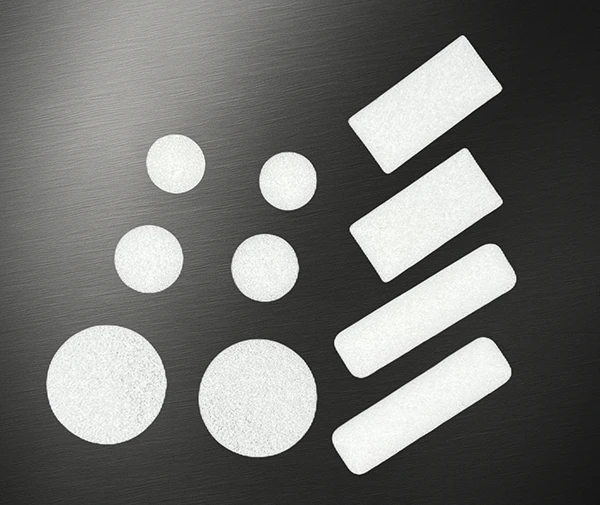
M.A. Industries brings your custom porous plastic solution from concept to full production, maintaining close communication and attention to your specifications every step of the way.
A successful porous plastic component starts long before full-scale production. Material selection, pore size, airflow, filtration requirements, and dimensions can all affect how a finished porous component performs.
M.A. Industries works with customers from the earliest stages of product development through prototyping, testing, design refinement, and production manufacturing. Whether you have a finished drawing or a performance requirement, our goal is to help turn that concept into a porous plastic part that can be manufactured consistently and economically.
Discuss your applicationPorous plastics can provide filtration, diffusion, venting, wicking, and controlled flow by allowing gases or liquids to pass through an interconnected pore structure.
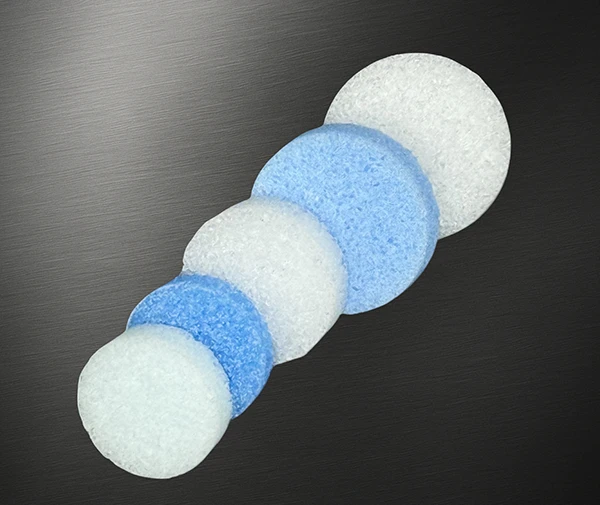
Porous plastics can perform functions that are not possible with conventional injection molded components. Controlled porosity allows fluids, liquids or gases, to pass through the material while the interconnected pore structure can provide filtration, diffusion, venting, wicking, or controlled flow.
That versatility also means that designing a porous plastic part involves more than specifying its outside dimensions.
Our concept-to-production process considers both the physical design of the component and the performance characteristics of the porous material. The objective is to develop a part that performs as desired by the customer while being practical to manufacture at the required production volume.
The process begins by understanding what the component needs to accomplish.
Depending on the application, important design considerations may include:
Early collaboration can help identify which characteristics are critical and which can be adjusted to improve production efficiency.
Selecting the appropriate material is an important part of porous component development.
Polyethylene and Polypropylene can provide a useful combination of chemical resistance, durability, lightweight construction, and controlled permeability. The appropriate material and porous structure depend on the environment in which the component will operate and the function it must perform.
Material selection varies based on end use factors such as chemical compatibility, temperature, hydrophobic or hydrophilic behavior, and the size of particles or droplets that need to be controlled.
The goal is not simply to select a plastic resin, but to develop the combination of material, pore structure, and geometry appropriate for the application.
Prototypes allow a design to move from theoretical specifications to a component that can be evaluated under actual or simulated operating conditions.
Depending on the project, prototype parts can be used to evaluate characteristics such as:
Prototype development is especially valuable for custom porous plastic components because small changes in dimensions, thickness, pore structure, or material can influence performance.
Rather than committing immediately to a production design, prototyping provides an opportunity to identify these variables early in the development process.
A prototype is often the beginning of the engineering process rather than the end.
Testing can reveal opportunities to improve performance or simplify the component before production tooling and manufacturing procedures are finalized. A design may require changes to geometry, material, pore size, or the way the porous component interfaces with surrounding parts leading to a new prototype being developed.
This iterative process helps answer an important manufacturing question:
Can the component provide the required performance consistently when produced at scale?
By considering production requirements during the prototyping stage, a customer can depend on reliable supply, consistent pricing, and desired quality throughout full-scale production.
A component that works as a prototype must also be practical to manufacture repeatedly.
Design for manufacturing considers how part geometry, tolerances, material requirements, secondary operations, and expected quantities affect the production process.
Where appropriate, we can work with customers to identify changes that simplify manufacturing without compromising the intended function of the component.
This may include evaluating:
Addressing these considerations before production can reduce unnecessary complexity and help establish a more reliable manufacturing process.
Once the design and performance requirements have been established, the project can transition into full-scale production.
Because manufacturing considerations have been incorporated throughout development, the transition from prototype to production is not an entirely separate process. Material specifications, component geometry, performance requirements, tooling, and manufacturing procedures have already been evaluated as part of the development cycle.
The result is a defined porous plastic component designed for its intended function and consistent manufacturing.
It can be tempting to completely engineer a component before approaching a manufacturer. With porous materials, earlier collaboration can often produce better results.
Porosity introduces variables that do not exist with conventional injection-molded or machined plastic components. Airflow, pressure drop, pore size, and component geometry can interact in ways that affect both performance and manufacturability.
The earlier these factors are considered, the easier it is to design a component around both performance and production.
Not every project begins with a new product concept.
We also work with customers who need to modify an existing porous component, replace a discontinued part, improve the performance of an existing design, replace an expensive or unreliable supplier, or investigate porous plastic as an alternative to another filtration, venting, diffusion, or flow-control technology.
Projects can begin with engineering drawings, specifications, existing samples, or performance requirements.
From the first prototype to full-scale production quantities, M.A. Industries can help develop porous plastic components around your application needs.
If you are developing a new product, redesigning an existing component, replacing an existing supplier, or evaluating whether porous plastic could provide a better solution, talk with us early in the process.
Bring us the design. M.A. will help develop the path to a production part.
Contact M.A. Industries